
Key Takeaways
- ›The copper phone network (POTS) is being retired. AT&T began permanently decommissioning copper in 2026 and has said it wants nearly all copper phone lines gone by 2029.
- ›The FCC cleared the way in 2026 — cutting red tape and shortening the required notice — so once your line is scheduled for shutdown you may have as little as 90 days to move.
- ›It isn’t just desk phones. Fax lines, fire-alarm dialers, elevator emergency phones, and gate/callbox lines often still run on copper — and several are life-safety systems you’re legally required to keep working.
- ›The fix is internet-based phone service (VoIP) plus a plan for the non-phone lines. Porting numbers and setting up 911 takes time, so start before a disconnect notice lands.
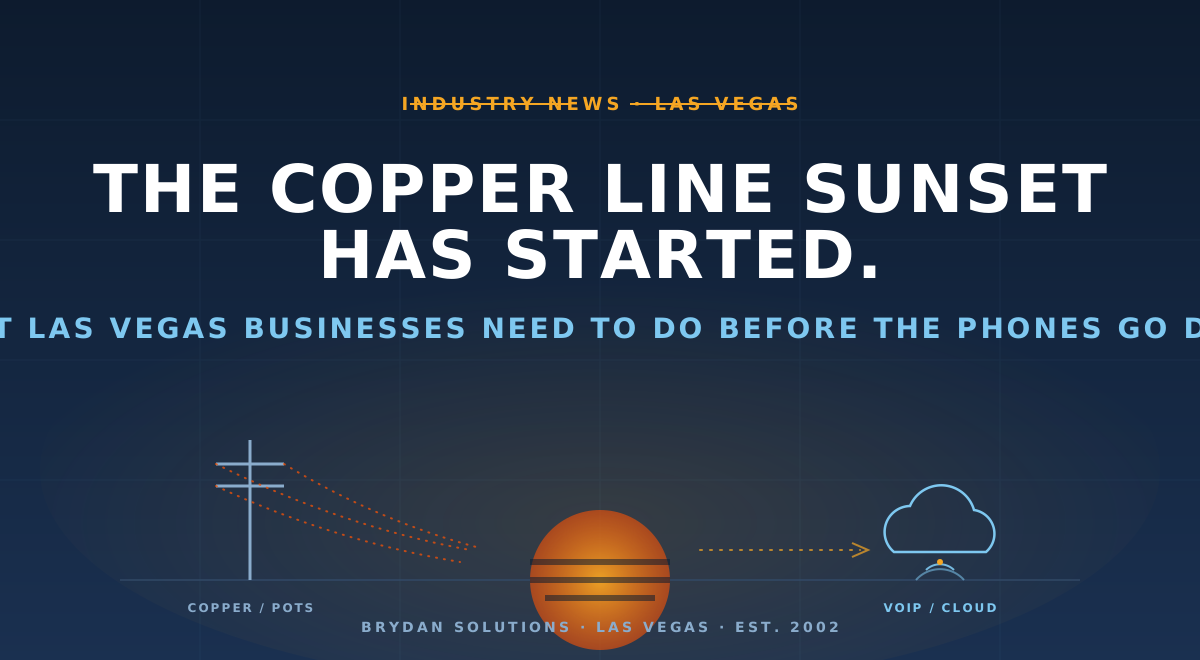
There’s a quiet infrastructure change happening that most Las Vegas business owners haven’t heard about yet: the copper landline network that has carried business phone calls for a century is being switched off. Not upgraded — switched off.
For a lot of owners the reaction is “so what, we use cell phones and Teams anyway.” And for day-to-day calling, fair enough. But copper lines are still quietly doing jobs in most commercial buildings — the fax machine, the fire-alarm dialer, the elevator emergency phone, the alarm panel — and those are the ones that bite you when the dial tone disappears.
Here’s what’s actually happening, which of your lines are affected, and what to do about it before you get a disconnect notice with a short clock attached.
What’s Actually Happening
AT&T is the largest provider of copper “POTS” lines (plain old telephone service) in the country, and it has been clear that copper is on its way out. In 2026 it began permanently decommissioning copper in its first wave of wire centers — the local facilities that serve entire neighborhoods — after getting the green light from the FCC, and it has publicly targeted retiring virtually all of its copper phone lines by 2029.
Just as important, the FCC spent 2026 removing the regulatory hurdles that used to slow copper retirement down: streamlining approvals, trimming disclosure requirements, and shortening the notice carriers have to give before a wire center goes dark — down to as little as 90 days for affected customers. Translation: this is moving faster than it used to, and the window you get to react is shorter than it used to be.
None of this is Las Vegas-specific — it’s a national transition. But it tends to land hardest on established local businesses whose buildings and systems were wired years ago and haven’t been touched since. If your phones, fax, or alarms have “just worked” for a decade, that’s exactly the setup that gets caught off guard.
It’s Not Just Your Desk Phones
This is the part that surprises people. Long after a business moves its actual calling to cell phones or a softphone, a handful of copper lines are usually still in the building doing critical jobs in the background:
| On copper today | What it does | Where it moves |
|---|---|---|
| Desk phones / PBX trunks | Business calling | VoIP (calls over internet) |
| Fax line | Faxing | Cloud/eFax, or an adapter (ATA) over VoIP |
| Fire-alarm dialer | Auto-calls the monitoring center | Cellular or IP alarm communicator (code-compliant) |
| Elevator emergency phone | Life-safety call for help | Cellular/VoIP line that meets code |
| Alarm / access-control panel | Security monitoring | IP or cellular path |
| POS / modem lines | Card or data over POTS | Internet-based connection |
Two of those — the fire-alarm dialer and the elevator emergency phone — are life-safety systems, and keeping them working is a code requirement, not a nice-to-have. When the copper behind them goes away, “there’s still dial tone” is not something you can assume. That’s why this can’t be a last-minute swap of the office phones and nothing else.
What Replaces It — and Why Your Internet Matters More Now
For the phones themselves, the replacement is VoIP — voice that travels over your internet connection instead of a copper pair. It’s usually cheaper than legacy lines and comes with features copper never had: voicemail-to-email, softphones on laptops and cell phones, easy add/remove of extensions, and keeping your existing business number.
But there’s a catch worth being honest about. Once your calls ride your internet, your internet connection becomes business-critical. If it drops, your phones drop with it. That’s not a reason to avoid VoIP — it’s a reason to make sure the connection underneath it is solid and has automatic failover: a second connection that takes over the moment the primary one hiccups, so a single outage doesn’t take your phones down with it.
The life-safety lines — alarms and elevator phones — are a separate conversation. They generally need purpose-built cellular or IP communicators that meet fire and building code, installed by the right licensed vendor. A softphone app is not a substitute for those. Getting them handled correctly is exactly the kind of thing that gets forgotten until an inspection or an emergency exposes it.
Where Las Vegas Businesses Get Tripped Up
- Waiting for the disconnect notice. By the time the letter arrives you may have around 90 days — not enough runway for number porting, alarm and elevator work, testing, and any inspections all at once.
- Assuming number porting is instant. You can keep your existing business numbers, but moving them between carriers takes time and coordination. Rushing it is how businesses end up with a gap where customers can’t reach them.
- Skipping 911 (e911) setup. VoIP 911 has to be registered to each physical location so emergency crews get the right address. This is easy to overlook and genuinely dangerous to get wrong.
- Forgetting the old building systems. Valley properties with legacy fire, elevator, or gate systems on copper need a compliant replacement path — not a DIY swap — to stay code-compliant.
What to Do in the Next 90 Days
You don’t need to panic, but you do need a plan before a notice forces the timeline. Six concrete steps:
- Inventory every line. Walk the building and list them all: desk phones, fax, fire-alarm dialer, elevator phone, gate/callbox, alarm panel, any modem or POS line. Note the carrier and which ones are copper/POTS.
- Flag the life-safety lines first. Fire-alarm and elevator emergency phones are code-required. They need a compliant replacement and the right licensed vendor, so they take the longest — start here.
- Choose your voice path. Move the phones to VoIP, decide cloud fax vs. an adapter for any fax lines, and plan cellular/IP for the alarms and elevator.
- Harden the internet it now depends on. Confirm your connection can carry voice cleanly and add automatic failover so one outage doesn’t knock out your phones.
- Port numbers and set up e911 early. Begin porting well before any disconnect date, and register 911 to every physical location.
- Get ahead of the notice. Do this while it’s a calm planned project. The alternative is doing it in a scramble after the fax or alarm has already gone dark.
The Bigger Picture
The copper sunset is one piece of a broader shift — legacy telecom giving way to internet-based everything. It’s the same reason the vast majority of small businesses now lean on a managed IT partner: there’s simply more infrastructure to keep straight than an owner can track while also running the business.
The businesses that come through this cleanly treat it as a planned project — inventory, sequence, port, test — months before their number comes up. The ones that don’t usually find out the hard way, when a customer says a fax never arrived or an inspector flags a dead elevator phone. The good news: you’re reading this early enough to be in the first group.
Sources: FCC — Technology Transitions / copper retirement proceedings, and AT&T’s 2026 copper-retirement (Section 214 discontinuance) announcements.
Talk to Brydan
Is Your Phone System Ready for the Copper Sunset?
Brydan Solutions plans and manages business VoIP phone systems, internet with automatic failover, and the life-safety lines that ride alongside them — for businesses across the Las Vegas Valley and Nevada. We’ll inventory what you have on copper and map the move before a disconnect notice ever shows up.
About the Author
Brydan Solutions is a veteran-owned, minority-owned managed IT and cybersecurity provider based in Las Vegas, serving Nevada businesses since 2002. Our team manages IT, cybersecurity, business phones, connectivity, and business continuity for small and mid-sized organizations across the Las Vegas Valley and remotely nationwide. Learn about our team or talk to a real person.
Continue Reading